
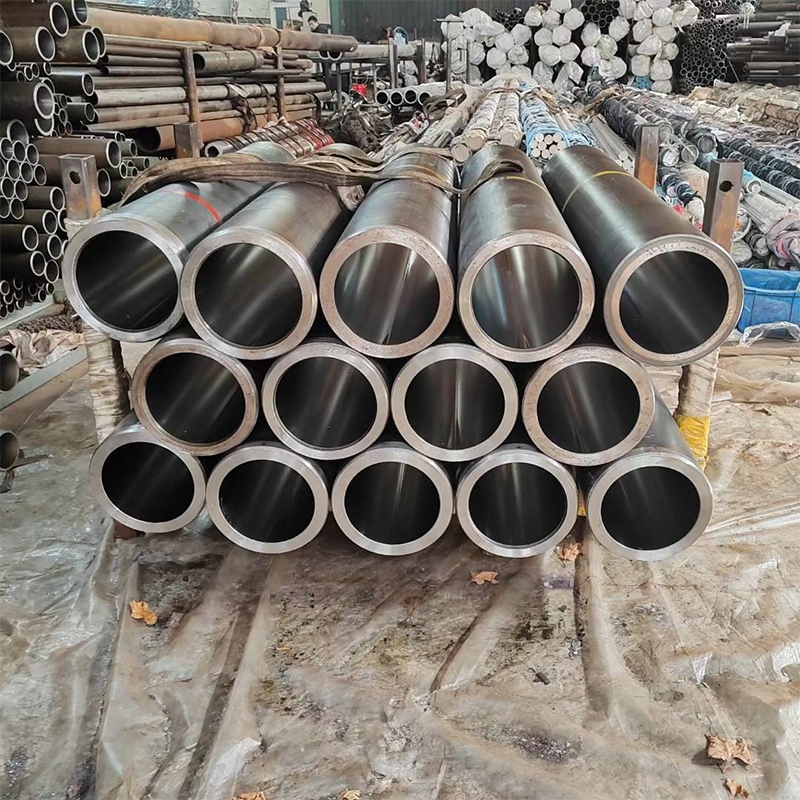
When purchasing cold drawn honed tubes, the key points are material, precision, manufacturing process, inner surface quality and pressure resistance, so as to avoid low-quality products such as ordinary polished tubes passing off as honed tubes or false tolerance marking. The following practical standards can be directly used for inspection and selection.
1. Select the Right Material According to Working Conditions
Choosing the wrong material will easily lead to cracking, rusting or premature failure even with high precision.
- 20# carbon steel: For medium and low pressure hydraulic, pneumatic and general mechanical parts, cost-effective.
- 45# carbon steel: Commonly used for hydraulic cylinder barrels, with moderate strength and good wear resistance.
- 27SiMn / 40Cr alloy steel: For heavy-duty, high-pressure applications such as construction machinery and mine hydraulic supports.
- 304 / 316L stainless steel: For corrosive environments, chemical industry, food processing, marine and seawater applications.
Key point: Always ask for material certificates and quality assurance documents; reject products with unknown or mislabeled steel grades.
2. Check Dimensional Precision: Ensure Tolerances Are Truly Met
Dimensional accuracy is the core value of honed tubes. False tolerance marking makes the product practically useless.
Key inspection items:
- Inner diameter tolerance: Normally H7, H8, H9; H7 is preferred for high-end hydraulic cylinders.
- Straightness: Generally required to be ≤ 0.15 mm/m.
- Roundness and ovality: Controlled within 0.01 mm for high-quality products.
- Length tolerance: For fixed-length tubes, generally within ±5 mm.
You can require third-party inspection or on-site sampling with calipers and internal gauges.
3. Inner Surface Quality: Real Honing vs. Fake Polishing
Many low-cost products use ordinary polished tubes to imitate honed tubes, resulting in much shorter service life.
Features of genuine cold drawn honed tubes:
- Uniform cross-hatch pattern on the inner wall, which helps retain oil and protect seals.
- Roughness Ra 0.2–0.8 μm (commonly Ra 0.4 for hydraulic cylinders).
- No obvious scratches, pits, black spots or oxide scales.
- Smooth inner surface with uniform color, no steps or tool marks.
Simple judgment: The inner wall feels smooth, not rough, and has no obvious longitudinal lines.
4. Inspect Outer Surface and Overall Appearance
- No cracks, folds, laps or rust on the outer surface.
- Flat end cutting without burrs or deformation.
- Straight overall length with proper straightening.
- Consistent lengths without mixed sizes.
Poor appearance usually indicates inferior internal structure and dimensional stability.
5. Pressure Resistance and Mechanical Properties
Especially for cylinder barrels and high-pressure cylinders, the following must be verified:
- Appropriate hardness (within the standard range for different materials).
- Qualified tensile strength and yield strength.
- Low residual stress to avoid deformation or oil leakage after assembly.
- Passes pressure test, flaring test and flattening test without cracking.
Formal manufacturers provide mechanical property reports and flaw detection reports.
6. Production Process: Must Be “Cold Drawing + Honing”
Qualified production flow:
Raw tube → Pickling and phosphating → Cold drawing → Heat treatment / straightening → Fine honing → Inspection → Packaging
- Cold drawing without honing: Rough inner wall, easy seal damage.
- Polishing without honing: No cross-hatch, poor oil retention, easy cylinder creep.
Low-cost tubes often skip heat treatment, fine honing or flaw detection, leading to high failure rates.
7. Manufacturer Strength and Inspection Capacity
Reliable suppliers usually have:
- In-house cold drawing and honing machines, not just resellers.
- Capability for eddy current testing, ultrasonic testing and hydrostatic testing.
- Support for customized sizes, non-standard tolerances and special lengths.
- Ability to provide certificates, inspection reports and quality guarantees.
Choose original factories to avoid price markup and uncontrolled quality.
8. Price Comparison: Do Not Only Pursue Low Prices
Costs of honed tubes mainly come from material, cold drawing passes, honing time and inspection.
Products significantly below market price often have defects:
- Used or refurbished tubes.
- Enlarged tolerances and substandard precision.
- Omitted flaw detection and heat treatment.
- Serious negative deviation of wall thickness.
For hydraulic, cylinder and construction machinery applications, losses from oil leakage, cylinder burst or downtime far exceed the price difference.
Quick Summary
Choose a qualified manufacturer, select the correct material (20# / 45# / 27SiMn / stainless steel) based on working conditions, confirm inner diameter precision H7–H9, honed cross-hatch, roughness Ra 0.2–0.8 and qualified straightness, and ask for material and inspection reports — this is how you get high-quality cold drawn honed tubes.